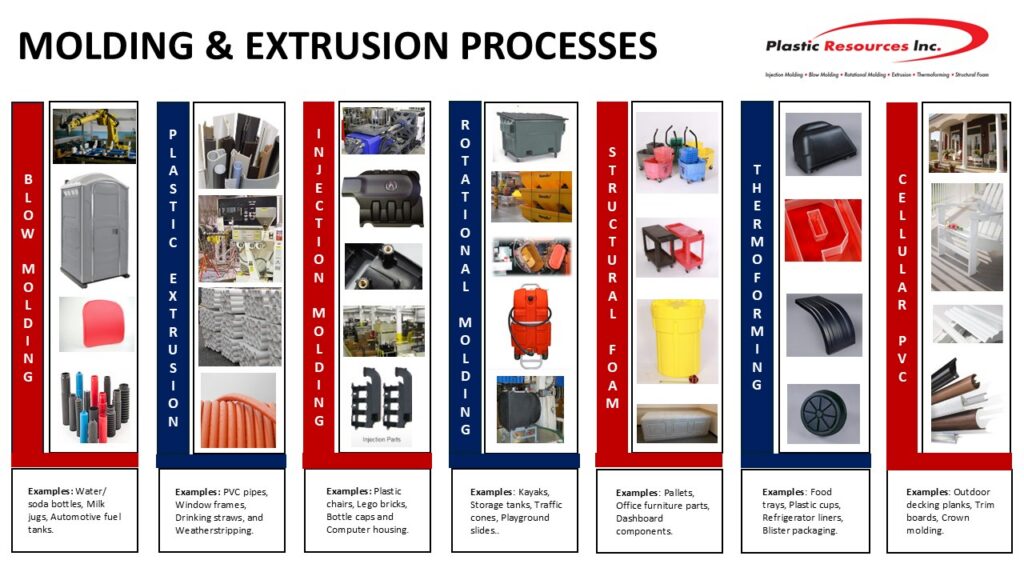
Plastic manufacturing uses many methods to shape raw plastic into useful parts. Each process works best for specific shapes, production amounts, and material types. Plastic Resources, Inc. (PRI), can guide you in process and material selection and help you get results.
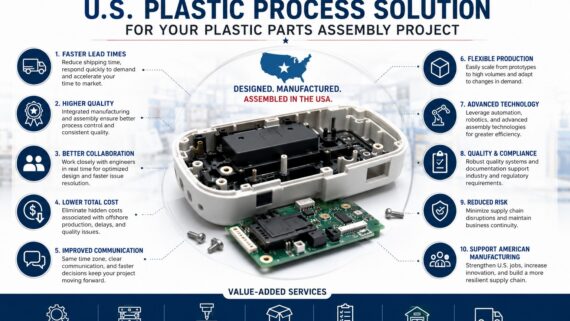
Request a copy of our latest infographic:
Plastic Industry Processes Today
How it works: Air is blown into a warm plastic tube (parison) to expand it against a hollow mold.
Best uses: Hollow items like bottles, jugs, and automotive tanks.
Key benefit: Creates uniform, thin walls for hollow shapes efficiently.
How it works: Plastic pellets melt and push through a shaped die in a continuous stream.
Best uses: Pipes, tubes, window frames, and weather stripping.
Key benefit: Makes long parts with a constant cross-section at a high speed.
How it works: Molten plastic is forced under high pressure into a closed metal mold.
Best uses: Complex solid parts like Lego bricks, bottle caps, and computer housings.
Key benefit: High precision and fast cycles for large production runs.
How it works: Plastic powder goes inside a hollow mold that rotates slowly inside an oven.
Best uses: Large items like kayaks, storage tanks, and trash cans.
Key benefit: Low mold costs and stress-free parts with even wall thickness.
How it works: Nitrogen gas is injected into the molten plastic inside the mold to create a hollow core or cellular inner structure.
Best uses: Thick parts, automotive handles, and heavy-duty business machine cases.
Key benefit: Reduces part weight and prevents surface sink marks.
How it works: A flat plastic sheet is heated until soft, then sucked or pressed over a mold.
Best uses: Food packaging, disposable cups, and plastic truck bed liners.
Key benefit: Great for large, shallow parts with low tooling costs.
How it works: PVC material is mixed with a foaming agent during extrusion or molding to create a lightweight, rigid foam core with a smooth outer skin.
Best uses: Trim boards, crown molding, and outdoor decking.
Key benefit: Resists moisture and rot while acting as a wood alternative.
Need help on your next project? Talk to the experts at Plastic Resources, Inc. (PRI) today at 614-471-9478 or email us at info@plastic-resources.com.
Keep Plastic Resources in mind for your plastic parts projects. We’re ready to help when you need us.
FIND OUT MORE ABOUT OUR PLASTIC PROCESS SOLUTIONS
Blow Molding Plastic Extrusion Injection Molding Rotational Molding
Structural Foam/Gas Assist Thermoforming/Vacuum Forming Cellular PVC Extrusion